

A Life Saved Automatically: CPR and an AED Save a Man in California
Updated October 2026 with current CPR and AED guidance.
A normal dinner out turned into a life-or-death emergency in Cayucos, California, when a 74-year-old man suddenly collapsed on a sidewalk.
Nearby bystanders rushed to help.
Then law enforcement arrived with an automated external defibrillator, or AED.
The combination of bystander CPR and early AED use helped save the man’s life.
A Bystander Saw the Man Collapse
Ben Hunt was eating dinner with his wife at a nearby restaurant when he looked through the window and saw a man collapse across the street.
The couple immediately went outside to help.
According to the original account, Hunt checked the man, found no signs of circulation, and began chest-compression CPR.
His wife helped.
Another woman who happened to be passing by and also knew CPR joined the effort.
Several ordinary people had suddenly become the first links in the Chain of Survival.
Bystander CPR Kept Blood Moving
Today, a lay rescuer does not need to spend valuable time trying to confirm a pulse.
Current American Heart Association guidance says that when an adult is unresponsive and not breathing normally or is only gasping, a lay rescuer should assume cardiac arrest, call 911, and begin CPR. cpr.heart.org
That is why quick bystander action matters.
CPR helps keep some blood flowing to the brain and other vital organs while an AED and emergency medical help are on the way.
The American Heart Association reports that immediate CPR can double or triple a person’s chance of survival from out-of-hospital cardiac arrest. American Heart Association
Sheriff’s Deputies Arrived With an AED
The 911 call brought two San Luis Obispo County sheriff’s deputies to the scene.
One deputy took over CPR.
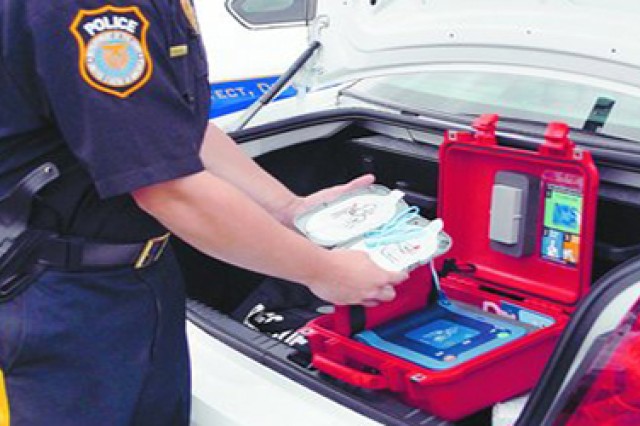
The other went to the patrol vehicle and retrieved an AED.
The device analyzed the man’s heart rhythm and delivered treatment.
According to the original account, the AED helped restore an effective heart rhythm.
Paramedics then transported the man to the hospital, where he was reported to be alert and talking with family members.
What Does an AED Actually Do?
An AED is a portable device designed to identify certain dangerous heart rhythms and deliver an electrical shock when appropriate.
The important part is this:
The AED decides whether a shock is needed.
The rescuer does not need to diagnose the heart rhythm.
Modern AEDs provide step-by-step voice or visual instructions, and they will not advise a shock unless the device detects a rhythm that can benefit from defibrillation. The American Heart Association specifically notes that anyone can use an AED, even though training is still recommended. www.heart.org
CPR and an AED Work Together
CPR and an AED do different jobs.
CPR helps maintain blood flow.
An AED may be able to correct certain dangerous electrical rhythms that cause cardiac arrest.
That is why modern cardiac-arrest response is often summarized as:
Call 911. Start CPR. Get an AED.
When the AED arrives:
- Turn it on
- Attach the pads
- Follow the prompts
- Make sure nobody is touching the person during rhythm analysis
- Deliver a shock if instructed
- Resume CPR immediately when told to do so
The sooner CPR and defibrillation begin, the better the chance of survival.
Cardiac Arrest Is Not the Same as a Heart Attack
The original article described the man as a “heart attack victim.”
That terminology deserves an update.
A heart attack happens when blood flow to part of the heart muscle is blocked.
Cardiac arrest happens when the heart suddenly stops pumping blood effectively.
A heart attack can lead to cardiac arrest, but the two are not the same.
Because the man in this story collapsed, required CPR, and was treated with an AED, the immediate emergency was cardiac arrest.
AEDs Are Designed for Public Use
AEDs are now commonly found in places such as:
- Schools
- Airports
- Gyms
- Churches
- Offices
- Government buildings
- Sporting facilities
- Shopping centers
You do not need to be a doctor, nurse, or paramedic to use one.
The AHA’s current guidance emphasizes that public access to AEDs matters because defibrillation can be lifesaving when cardiac arrest is caused by a shockable rhythm. www.heart.org
Why CPR and AED Training Matter
This rescue happened because several things went right.
A bystander recognized the emergency.
CPR began quickly.
911 was called.
Law enforcement arrived with an AED.
Paramedics continued the man’s care.
No single step worked alone.
Together, they formed a Chain of Survival.
The 2025 American Heart Association guidelines continue to emphasize rapid recognition, high-quality CPR, and early defibrillation as core parts of successful cardiac-arrest response. professional.heart.org
Learn CPR and AED Skills Before an Emergency
In-Pulse CPR provides hands-on American Heart Association CPR, BLS, AED, and First Aid training for individuals, healthcare professionals, and workplaces.
👉 View Upcoming CPR and AED Classes
Businesses, schools, churches, and other organizations can also schedule private training for employees or groups.
👉 Learn About Private On-Site CPR and AED Training
The man in Cayucos did not know he would need CPR that evening.
Ben Hunt did not know he would be the person called upon to help.
That is exactly why training happens before the emergency.
Updated October 2026: This article has been substantially revised to distinguish cardiac arrest from heart attack and to reflect current American Heart Association guidance on bystander CPR, AED use, and the Chain of Survival.
